AUSKF Special Article
When the Pacific War ended and Occupation of the Allied Powers began, they took measures to eliminate Japan’s potential to wage war. Among the institutions considered to be the roots of militarism was the Dai Nippon Butokukai (Great Japan Martial Virtue Association). This was the umbrella organization for kendo, judo, kyudo (Japanese archery) and naginata (glaive, pole arm), and as such, was ordered to disband in November 9, 1946. However, it had dissolved itself on October 31, 1945.
In 1948 the Allied Powers issued orders that kendo and judo could be reinstated as physical training for Japanese police. Most of the police at that time had served in the Japanese armed forces, and had grown up with Butokukai kendo and during the war years, many had been drilled in shin ken kendo (live sword kendo). Shin ken kendo prepared one to use the sword in combat. The shinai (bamboo sword was 36 sun (Japanese inches =109 cm) long; about the length of a gunto (army issue sword). The practice was predominantly owaza (large motion techniques) with great emphasis on tenouchi (within the hand), the movement of the fingers and writs, while grasping the hilt when cutting. This was of the utmost importance in controlling the blade when actually cutting in combat. Both men and do cuts were followed by a slicing movement immediately after the shinai made contact, with a concurrent lowering of the hips. In the police dojo ashi-barai (foot sweeping), tai-atari (colliding with the opponent), were routine; as well as the practice of grappling with the opponent and attempting to remove his men (mask) when he dropped his shinai in practice.
The Tokyo police in attempting to control the disorder that accompanied the Communist May Day demonstrations, May 1, 1949, used the jo (staff) for crowd control. The GHQ provost Marshall (Beigun Soshireibu Kempeitai-cho) had seen that some of the Communists had been able to seize some of the staffs and were beating the police with them. The provost marshall was able to have orders issued prohibiting kendo training for all police. Kendo was reinstated later in that year, but when practice resumed, those elements in kendo which were clearly associated with a real sword, such as the slicing movement after the cut, were not allowed; nor were blows delivered with as much strength as they had been prior to the ban.
In this same time 1945-1950, occurred another development having considerable influence on kendo - the introduction of foreign elements. These emerged largely from two sources: fencing and sports athletics. The Allied Powers permitted Japanese universities to have fencing classes. The first university to conduct western fencing classes was Meiji University in Tokyo, in 1945. On August of 1946, the Nippon Fuenshingu Kyokai (Japan Fencing Association) was established. Students wished to engage in kendo as a competitive sport. A sports kendo was created that would satisfy al the objections of the Occupation. Authorities had to even drop the word “kendo.' This sport kendo finally evolved into shinai kyogi (pliant competition). “Shinai' for kendo was written with one character, “shinau' (to be pliant) but its gerund form - which is “shinai.' Obviously a deception for the Occupation, which had rejected “bamboo sword.'
This shinai was not a complete falsehood. Today’s shinai is essentially a cylinder comprised of four pieces of bamboo. However, this early shinai was a most unusual type originating in the Tokugawa Period. A cylinder of eight pieces of bamboo split twice in thirds of its length to thirty-two pieces at the tip and encased in a soft leather sheath, pliant enough to be used without protective equipment, except for a European fencing mask to protect the eyes.
March 5, 1950, the Zen Nippon Kyogi Renmei (All Japan Kendo Federation) was established. Almost immediately the name was changed to Zen Nippon Shinai Kyogi Renmei (All Japan Pliant Competition Federation). In obtaining the initial permission to start practicing “shinai kyogi” several items permitted under rules of prewar kendo were specifically banned by the Occupation: ashi-barai, tai-atari, grappling when the shinai was dropped, and kiai (loud shouts).
In 1950 with the war in Korea, the Occupation sought ways to improve relations with the Japanese people. One approach was to drop all objections to the martial arts.
The Zen Nippon Kendo Renmei (All Japan Kendo Federation) was established October 14, 1952. It clearly set itself apart from the old Dai Nippon Butokukai. It was a sports organization with strong interest in spreading its kendo among youths and students, and as a sports organization, it conducted its affairs in a democratic manner. In March 1954 the Zen Nippon Kendo Renmei and Zen Nippon Shinai Kyogi Renmei merged under the name Zen Nippon Kendo Renmei Shinai kyogi itself did not last for very long thereafter.
The merger of the Zen Nippon Shinai Kyogi Renmei with the Zen Nippon Kendo Renmei would lead to a gradual influence of shinai kyogi technique on the kendo mainstream. The course of kendo for the future had been laid out at the time of the merger of the two federations. Essentially kendo was to be developed as a physical training sport founded by modern athletic sports guidelines as to match duration, court layout and judging by three referees. Moreover to eliminate those t things related to the feudal samurai tradition and actual use of the sword in combat. This led to the division of kendo instructors into two camps. One that continued support of kendo as it was done in the war, and those who had adopted the athletics sports approach as in the post war era as shinai kyogi.
The First Kokusai Shakajin Kendo Sekai Taikai (International World Kendo Grand Match) was held in Taipei, Republic of China November 21, 1960. Participating countries were Japan, Republic of China, United States of America, and Okinawa. This was a major step in the direction of international tournaments leading to changes in kendo techniques, the physical layout of the match area, and the posting of results. All of this would change substantially in the next thirty-five years. The third and last of the Shakaijin Kendo Sekai tournaments was held in Osaka, on October 8, 1967 with thirteen nations participating. These nations laid the foundation for the creation of the Kokusai Kendo Renmei (International Kendo Federation). It’s first Sekai Kendo Senshuken Taikai (International Kendo Championships) team matches were held in Tokyo, April 5, 1970 (team matches), and in Osaka on April 10 (individual matches), 1970.
Over the following thirty years, while there was relatively
little outward change in kendo dogu, the hakama and keikogi (except for
in some cases the substitution of synthetic for natural fiber textiles),
and much later the introduction of carbon graphite for bamboo in the shinai.
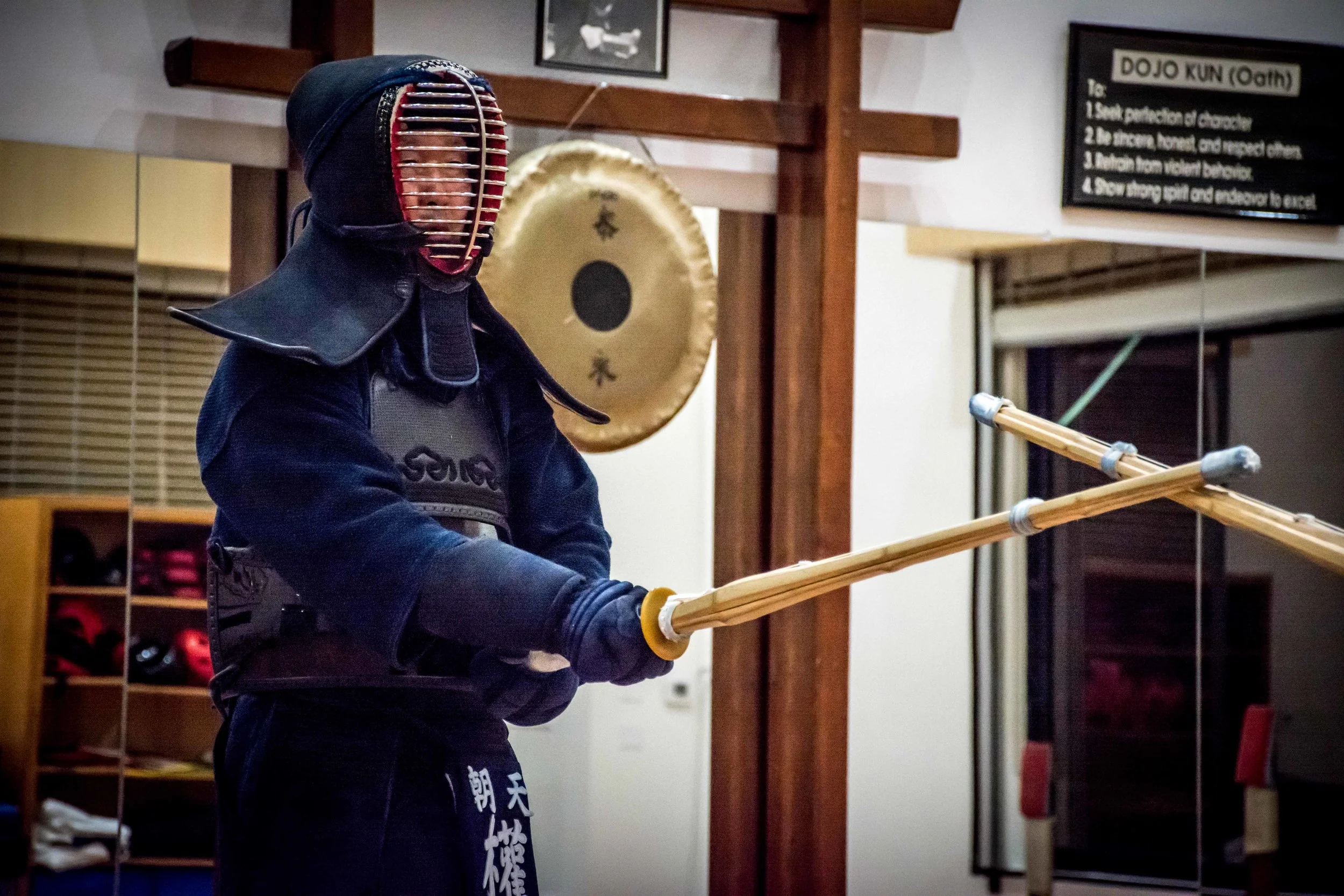
However, the bamboo shinai is still the dominant choice. The attitude
in the dojo has become increasingly relaxed, although individual dojo
may vary. Very recently a men with a clear plastic window has been introduced
on the metal grill at eye level. Few have been seen.
In 1970 those who participated in the matches had been trained to make their blows with tenouchi (finger and wrist action) and conclude the blow with shime as if the shinai were a sword, although directed toward the cut, it led to greater accuracy in striking areas of the men. This was still residual from pre-war kendo in preparing to use the sword.
Two separate groups that shaped the evolution of kendo from the establishment of the Zen Nippon Kendo Renmei in 1952-2000. The first was composed of traditionalists at the outset. Composed of instructors of historical Kenjutsu schools such as that of Ono-ha Ittoryu, Dai Nippon Buttokukai, Rikugun Toyama Gakko, and Tokyo Keishicho (Metropolitan Police Headquarters). All had taught kendo as preparation to using the sword in battle. This group has largely faded from the scene but their students still have some impact and the police are still quite active. The second group was a new element originating during the Occupation, comprised of instructors from the athletic departments of colleges and universities. They are responsible for the creation of shinai kyogi, a sanitized version acceptable to the Occupation. A sport in which their team would win in inter-collegiate competitions, which meant they search for ways to improve their team's performance by experimenting with methods borrowed from other sports and physical training.
There was considerable tension between the two groups in the first twenty or so years over the innovations and the attitude toward the role of kendo in building character.
While dogu and shinai remained essentially unchanged to the present, other changes drifted in the direction of the sports faction. In comparing the movement of the shinai in matches between the 1950' s and today; there is increased speed in which the shinai is moved when striking and defending, and a concurrent reduction in the strength of the strike on contact with the target. In the conduct of tournament matches, superficially, at first glance it resembles that of the early days. However, streamlining has taken place in almost every aspect of matches. For example: three hansoku was one point - now two hansoku is one point; the two line judges and their red and white flags have been eliminated. Perhaps the greatest, but most intangible difference is in the mental attitude of the contestants today.
|
|
||||||||||||||||||||||||
|
© 2003-2006 All United States Kendo Federation. All Rights Reserved Site Disclaimer:This website is posted as a service to the All United States Kendo Federation. Information on this website is posted from many different sources and every effort is made to post accurate information. Errors may occur and users use this site without warranties of any sort implied and at their own risk. |
|||||||||||||||||||||||||
The AUSKF...How the AUSKF is organized, It's Board of Directors and Affiliate Federation membership.
|
Find a Dojo...Use either of two methods for locating a Kendo Dojo. A listing of dojo's by State or by Regional Federation.
Please note that some dojo's belong to Regional Federations located outside of their geographical area.
|
News, Bulletins and Announcements...We will feature AUSKF News along with submitted affiliate Federation News and Announcements.
|
Interested in Kendo?....Some basic information regarding the origin of Kendo along with how practices are run, Kendo Kata, and descriptions of kendo equipment. Be sure to look for a local dojo if your interested in joining us.
|
Events.....Look here for upcoming events and seminars. Sponsored by both the AUSKF and Affiliate Federations.
|
Kendo Resource Links...This page has links to other kendo federation web pages, kendo equipment suppliers and a list of suggested books. Have some suggestions? Send them to: webmaster@auskf.org
|
Shinsa Study Guide......This is a study guide for those who will be participating in a promotion exam, or "Shinsa" ...........our "Kendo Cliff Notes"
|
AUSKF IAIDOThis section will contain as much information about Iaido functions and Instruction within the AUSKF as possible. Please check here first for Iaido information within the AUSKF. Iaido Instructors, we are looking for content!
|
Guest book.....Please sign and read our guestbook. Its looking a little thin after an unmentioned person re-set the log.
|
Kendo ArticlesKendo related articles will be located on this page. Please contact the webmaster if you would like to submit an article for inclusion in the webpage.
|